
Dengue Platelet Count Dropped to 80,000? What to Test, What to Ignore and When to Go to Hospital
Medically reviewed by Dr. Ayesha, Senior Consultant Pathologist, Index Path Labs and Fortis Hospital, Sector 62, Noida · Last updated: 16 September 2026
It’s day three of the fever. The CBC report arrives on WhatsApp and one line jumps out: Platelet count: 80,000.
Within minutes the family group fills up with advice. “Give papaya leaf juice.” “Kiwi and goat’s milk.” “Admit immediately!” “Don’t worry, it’s normal.”
If you’re reading this in Gaur City, Greater Noida West or Noida Extension this monsoon, you’re not alone. Let’s slow down and look at what actually helps: the right test on the right day, tracking the trend, and knowing the warning signs.
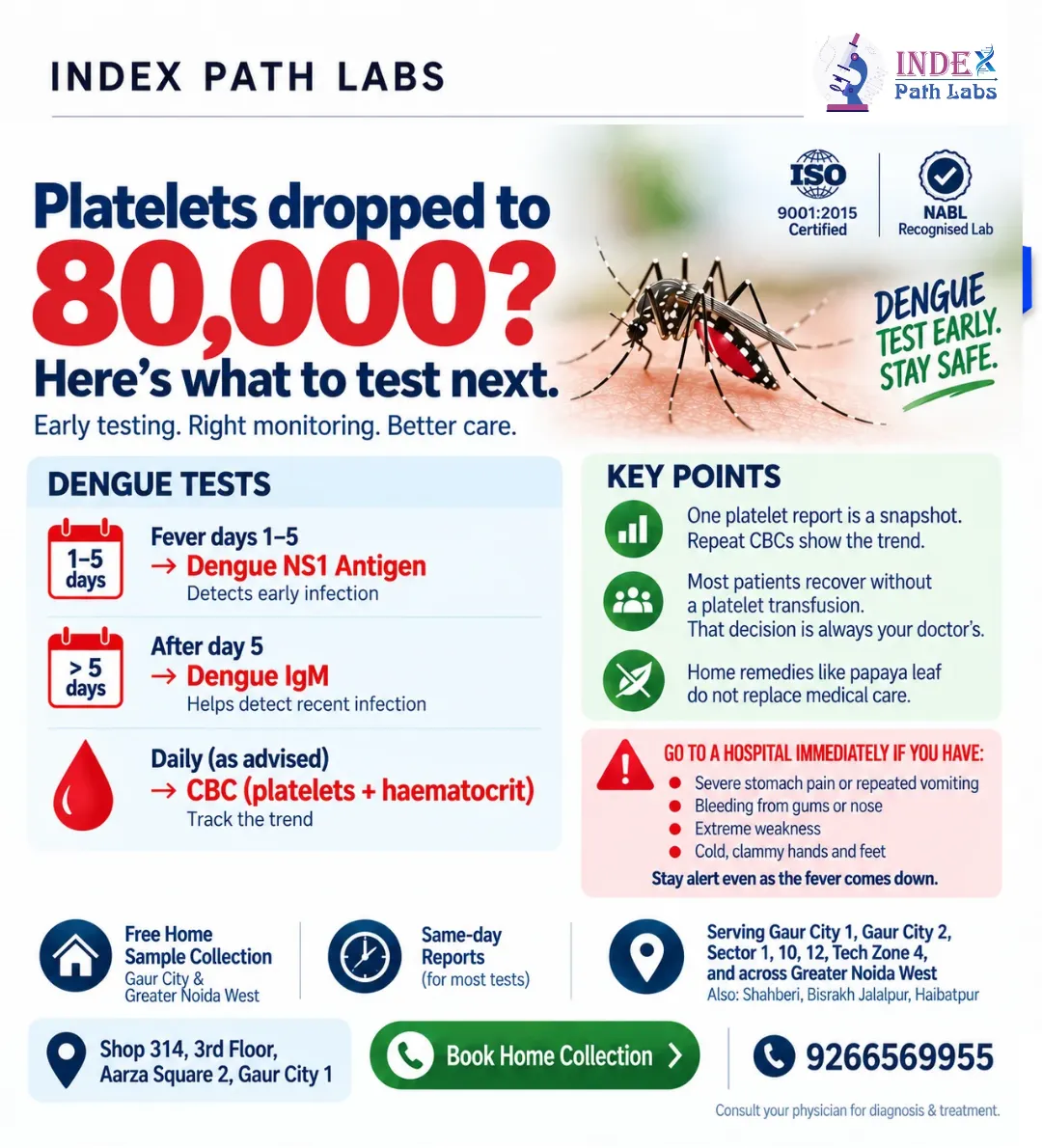
The short answer: a platelet count of 80,000 in dengue needs close monitoring and a doctor’s guidance, but on its own it is usually not a reason to panic. Doctors look at the trend over several days and at warning signs, not one number.
What Is a Normal Platelet Count, and What Does 80,000 Mean?
Platelets are tiny blood cells that help stop bleeding. Think of them as the “repair team” that seals small leaks in blood vessels.
| Platelet count (per µL) | What it generally means |
|---|---|
| 1,50,000 – 4,50,000 | Usual normal range (varies slightly by lab) |
| 1,00,000 – 1,50,000 | Mildly low |
| 50,000 – 1,00,000 | Moderately low; doctor will usually advise closer monitoring |
| Below 50,000 | Significantly low; needs prompt medical review |
In dengue, platelets commonly fall for a few days and then recover on their own as the body heals. So 80,000 falls in the “moderately low” band. It’s a signal to monitor carefully, not a verdict.
What matters more is:
- How fast the count is falling from one day to the next
- Haematocrit (HCT/PCV), which is also in your CBC. A rising haematocrit can suggest fluid leaking from blood vessels
- How the patient feels and whether any warning signs appear
Myth vs Fact: Papaya Leaf, Transfusions and “Fever Gone = All Clear”
Myth 1: “Papaya leaf juice cures dengue”
Fact: A 2019 systematic review of nine clinical trials found that papaya leaf extract was linked with higher platelet counts in some studies. But the evidence was rated low quality, and none of the trials measured the complications that matter most in dengue. The authors concluded that routine use cannot be recommended on current evidence.
In simple words: papaya leaf is not a substitute for testing, monitoring and your doctor’s care. If you want to try it, ask your doctor first, especially if the patient is vomiting.
Myth 2: “Low platelets always means a platelet transfusion”
Fact: Most dengue patients recover without a platelet transfusion. International guidance, including the US CDC’s dengue care guidelines, states that prophylactic (just-in-case) platelet transfusions are not recommended. Transfusions are for specific situations, such as significant bleeding, and that decision belongs to the treating doctor.
Myth 3: “The fever has gone, so the danger is over”
Fact: This is the most important one. The critical phase of dengue usually comes 3 to 8 days after the fever starts, often right when the fever settles. That’s when complications like fluid leakage can appear. Keep monitoring even after the thermometer looks better.
Myth 4: “Any painkiller is fine for dengue body ache”
Fact: Doctors advise avoiding aspirin and NSAIDs such as ibuprofen in suspected dengue, as they can increase bleeding risk. Paracetamol is the usual choice for fever, only as your doctor advises.
Which Dengue Test, When? NS1 vs IgM vs CBC
Getting the timing right saves you from a “negative” report that simply came too early.
| Day of fever | Test your doctor may advise | What it tells you |
|---|---|---|
| Days 1–5 | Dengue NS1 Antigen | Detects a dengue virus protein early in the infection. Can remain detectable up to about day 7 |
| Day 5 onwards | Dengue IgM Antibody | Detects the body’s early immune response to dengue |
| Every day or as advised | CBC (Complete Blood Count) | Tracks platelets, haematocrit and white cells, the trend doctors rely on |
Good to know: a negative NS1 or IgM result does not always rule out dengue. Your doctor will read the report alongside your symptoms. Not sure whether it’s dengue or a viral fever? Read our guide to dengue vs viral fever blood tests.
Why Daily CBC Tracking Matters More Than a Single Report
One report is a photograph. Daily CBCs are a video.
Imagine two patients in Gaur City 2, both at 80,000 today:
- Patient A: 95,000 → 88,000 → 80,000 → 84,000. Falling slowly, now turning up.
- Patient B: 1,60,000 → 1,10,000 → 80,000, with haematocrit rising.
Same number today, very different pictures. That’s why doctors often ask for a repeat CBC every 24 hours during the critical days.
The hard part is practical: taking someone with a fever and body ache to a lab every morning, through Char Murti traffic and a waiting room. That’s exactly where home sample collection helps. The sample comes to you, and the report comes to your phone.
🚨 Dengue Warning Signs: Go to Hospital Immediately
Don’t wait for the next report if you notice any of these:
- Severe stomach pain or tenderness
- Vomiting that won’t stop (repeated vomiting within a few hours)
- Bleeding from gums or nose, blood in vomit, stool or urine
- Unusual drowsiness, confusion or restlessness
- Extreme weakness, cold and clammy hands and feet
- Very little urine for several hours
- Breathlessness or swelling in the belly
These signs matter more than any single platelet number.
Frequently Asked Questions
Is a platelet count of 80,000 dangerous in dengue?
A count of 80,000 is moderately low and needs close monitoring, but it is not usually an emergency by itself. Doctors decide based on the daily trend, haematocrit and warning signs. Contact your doctor for guidance.
Does papaya leaf juice increase platelets?
Some small studies show a rise in platelet counts, but the evidence is low quality, and experts say routine use cannot be recommended. It should never replace testing, fluids and medical care.
When should I get the dengue NS1 test?
The NS1 antigen test works best in the first 5 days of fever. From around day 5 onwards, doctors usually add or switch to the dengue IgM antibody test.
How often should CBC be done in dengue?
Many doctors advise a CBC every 24 hours during the critical days (roughly days 3–8 of illness), but follow your own doctor’s schedule.
Can I get a dengue test and CBC at home in Gaur City?
Yes. Index Path Labs offers free home sample collection for dengue NS1, dengue IgM and CBC tests across Gaur City 1, Gaur City 2 and nearby Greater Noida West sectors, with same-day reports for most tests.
Which areas do you cover for home collection?
We collect samples across Gaur City 1 (Sector 4), Gaur City 2 (Sector 16C), Gaur Chowk, Sector 1, Sector 10, Sector 12, Tech Zone 4, Shahberi and nearby parts of Greater Noida West and Noida Extension.
Why Families in Greater Noida West Choose Index Path Labs
Index Path Labs is an ISO 9001:2015 certified diagnostic laboratory in Gaur City 1, Greater Noida West, offering free home sample collection and same-day reports for most tests.
- ✅ Free home sample collection, so no fever patient has to sit in a queue
- ✅ Same-day reports for most tests, sent straight to your phone
- ✅ Daily CBC tracking made simple during the critical dengue days
- ✅ ISO 9001:2015 certified processes
- ✅ Rated 5.0 on Google by 111+ patients from our neighbourhood
- ✅ Located at Arza Square 2, Gaur City 1, near Gaur Chowk
Book Your Dengue Test or CBC at Home
Fever in the family? Skip the queue. Book a home sample collection anywhere in Gaur City and Greater Noida West at indexpathlabs.in.
Medical disclaimer: This article is for general health awareness only and is not a substitute for professional medical advice. Test results must be interpreted by a qualified doctor. Consult your physician for diagnosis & treatment. In case of warning signs, go to the nearest hospital immediately.
References
- Centers for Disease Control and Prevention. Clinical Care of Dengue. https://www.cdc.gov/dengue/hcp/clinical-care/index.html
- Centers for Disease Control and Prevention. Clinical Testing Guidance for Dengue. https://www.cdc.gov/dengue/hcp/diagnosis-testing/index.html
- Rajapakse S, et al. Carica papaya extract in dengue: a systematic review and meta-analysis. BMC Complement Altern Med. 2019. https://link.springer.com/article/10.1186/s12906-019-2678-2
- World Health Organization. Dengue: Guidelines for Diagnosis, Treatment, Prevention and Control — Laboratory Diagnosis. https://www.ncbi.nlm.nih.gov/books/NBK143156/
Related Posts
Calcium and Vitamin D Testing: Why Bone Health Matters After Age 35
May 2025 Serving: Gaur City, Greater Noida West, Ghaziabad 5-minute…
Thyroid Test in Greater Noida West: When Should You Get Tested and What Does TSH Mean?
[vc_row][vc_column][vc_column_text]She thought it was just the stress of managing home,…
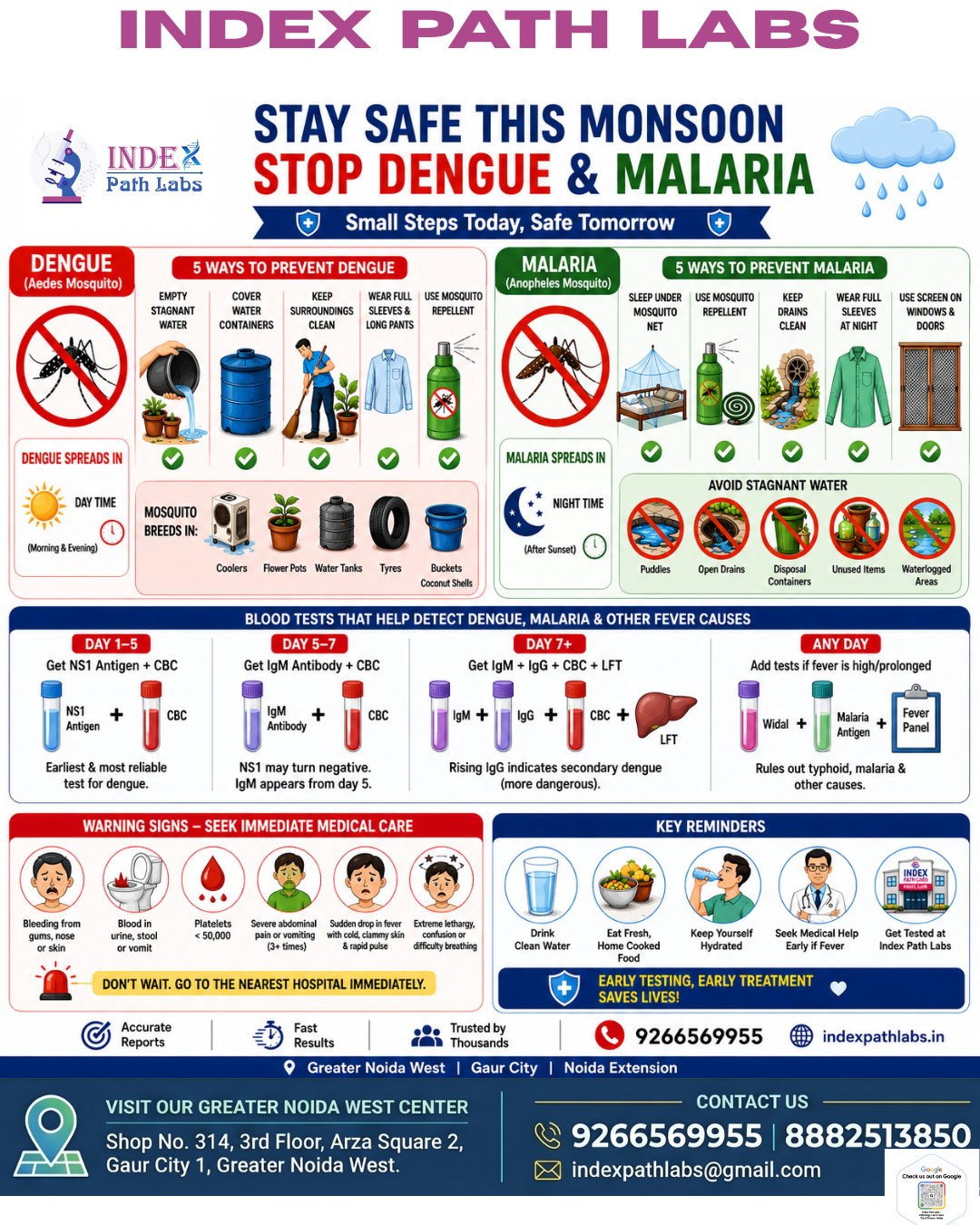
Dengue vs Viral Fever: Which Blood Tests Can Tell the Difference? | Index Path Labs
[vc_row][vc_column][vc_column_text] [caption id="attachment_1426" align="alignnone" width="1080"] stop dengue & malaria[/caption] Every…
One Reply to “Dengue Platelet Count Dropped to 80,000? What to Test, What to Ignore and When to Go to Hospital”