
She thought it was just the stress of managing home, kids, and work.
He assumed the weight gain was because he had stopped going for walks.
The elderly neighbour in Gaur City blamed her constant fatigue on “getting older.”
All three of them had one thing in common — an underactive thyroid. And all three went undiagnosed for months, sometimes years, because the symptoms of a thyroid problem look exactly like the symptoms of everyday life.
Thyroid disorders are among the most common — and most underdiagnosed — health conditions in India. Studies suggest that roughly 1 in 10 Indians has some form of thyroid disorder. And a large number of them do not know it yet.
If you live in Greater Noida West, Gaur City, or Noida Extension and have been feeling “off” without a clear reason — this blog is worth reading carefully.
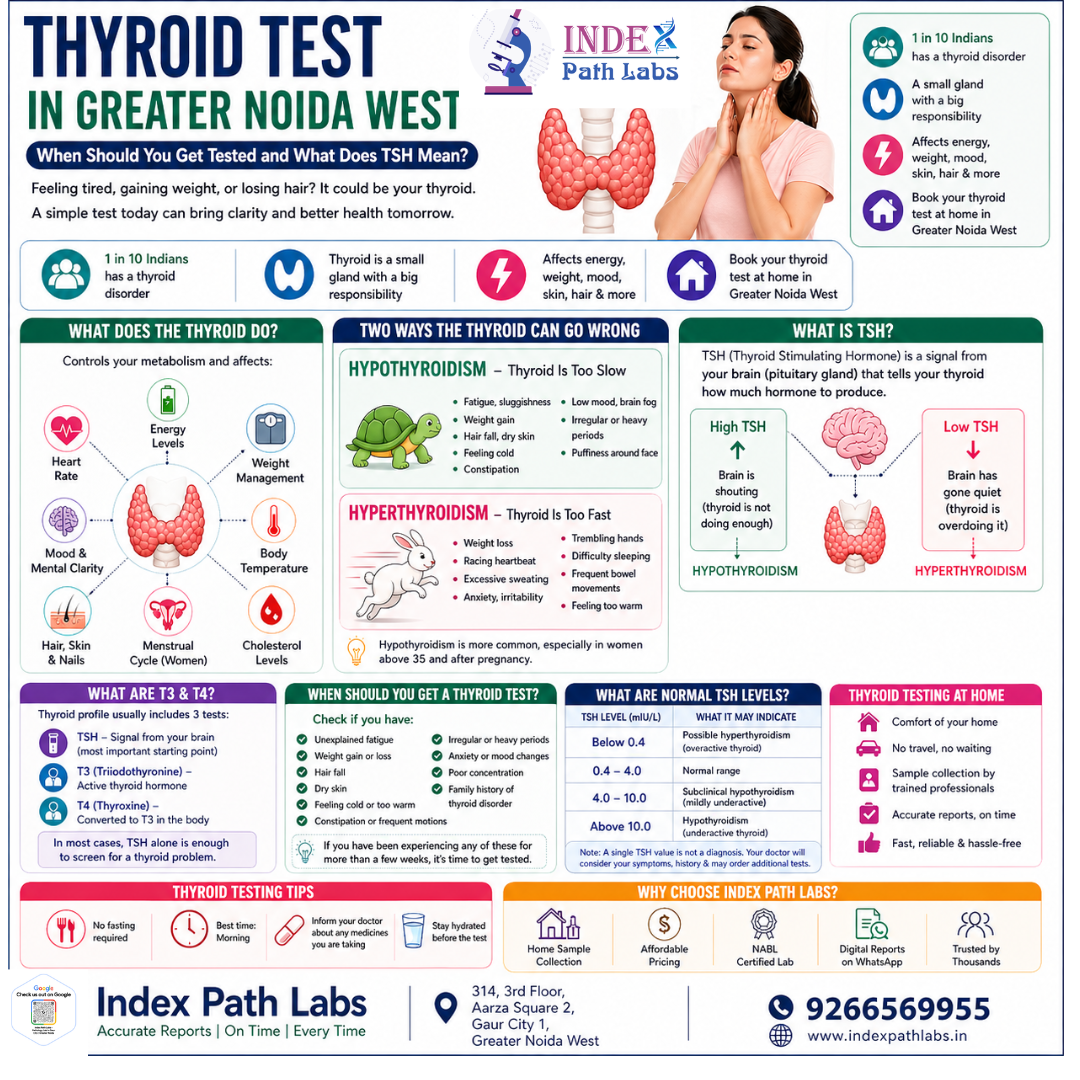
What Is the Thyroid Gland and What Does It Do?
Your thyroid is a small, butterfly-shaped gland sitting at the front of your neck, just below your Adam’s apple.
Do not let its size fool you. This small gland controls your metabolism — the process by which your body converts food into energy. It affects:
- How fast or slow your heart beats
- How quickly you gain or lose weight
- Your energy levels and how tired you feel
- Your body temperature
- Your mood and mental sharpness
- Your hair, skin, and nail health
- Your menstrual cycle (in women)
- Your cholesterol levels
When the thyroid works well, you barely notice it. When it does not — everything feels off.
Two Ways the Thyroid Can Go Wrong
Hypothyroidism — The Thyroid Is Too Slow
This is by far the more common problem. The thyroid is not producing enough hormones, so your body’s processes slow down.
Think of it like a car engine running on too little fuel — everything becomes sluggish.
Common symptoms:
- Constant fatigue — even after a full night’s sleep
- Unexplained weight gain despite no change in diet
- Hair fall or thinning hair
- Dry skin
- Feeling cold all the time, even in warm weather
- Constipation
- Low mood, brain fog, poor concentration
- Irregular or heavy periods in women
- Puffiness around the face
Hypothyroidism is particularly common among women — especially after pregnancy and after the age of 35. Many women across Gaur City and Greater Noida West are managing this condition without realising it.
Hyperthyroidism — The Thyroid Is Too Fast
Here the thyroid is overproducing hormones, making your body’s processes speed up.
Think of this as an engine running at too high a speed — burning out faster than it should.
Common symptoms:
- Unexpected weight loss despite eating normally
- Racing heartbeat or palpitations
- Excessive sweating
- Anxiety, nervousness, or irritability
- Trembling hands
- Difficulty sleeping
- Frequent bowel movements
- Feeling too warm all the time
Hyperthyroidism is less common than hypothyroidism but equally important to catch and treat early.
What Is a TSH Test?
TSH stands for Thyroid Stimulating Hormone.
Here is how it works in simple terms:
Your brain has a control centre called the pituitary gland. It constantly monitors how much thyroid hormone is in your blood. When thyroid hormone levels drop too low, the pituitary sends out more TSH — essentially shouting at the thyroid to produce more. When thyroid hormone levels are too high, the pituitary reduces TSH — telling the thyroid to calm down.
So TSH is not a thyroid hormone itself. It is the signal your brain sends to your thyroid.
This is why TSH works in reverse:
- High TSH → your brain is shouting because the thyroid is not doing enough → Hypothyroidism
- Low TSH → your brain has gone quiet because the thyroid is overdoing it → Hyperthyroidism
What Are Normal TSH Levels?
Standard normal range: 0.4 – 4.0 mIU/L
However, this range can vary depending on the laboratory and its equipment, your age, whether you are pregnant, and the time of day the sample was drawn.
Always compare your TSH value against the reference range printed on your report from your specific lab. Do not compare it to a range you found online.
| TSH Level | What It May Indicate |
|---|---|
| Below 0.4 | Possible hyperthyroidism (overactive thyroid) |
| 0.4 – 4.0 | Normal range |
| 4.0 – 10.0 | Subclinical hypothyroidism (mildly underactive) |
| Above 10.0 | Hypothyroidism (underactive thyroid) |
Important: A single TSH value is not a diagnosis. Your doctor will look at your symptoms, your history, and may order additional tests before confirming anything.
What Are T3 and T4 — and Do You Need Them Too?
When your doctor asks for a thyroid profile, it usually includes three tests:
- TSH — the signal from your brain (most important starting point)
- T3 (Triiodothyronine) — the active thyroid hormone
- T4 (Thyroxine) — another thyroid hormone, converted to T3 in the body
In most cases, TSH alone is enough to screen for a thyroid problem. T3 and T4 are usually checked when TSH is abnormal, or when your doctor needs a more complete picture.
If your doctor has written “Thyroid Profile” on your prescription — it typically means all three: TSH, T3, and T4.
When Should You Get a Thyroid Test?
Get a thyroid test if you have been experiencing any of the following — especially for more than a few weeks:
For hypothyroidism (underactive thyroid):
- Unexplained fatigue or sluggishness
- Gaining weight without eating more
- Hair fall or dry, rough skin
- Feeling cold when others around you feel fine
- Low mood or difficulty concentrating
- Constipation without a dietary reason
- Irregular or very heavy periods
For hyperthyroidism (overactive thyroid):
- Losing weight without trying
- Heart racing or beating irregularly
- Sweating more than usual
- Feeling anxious or restless without a clear cause
- Difficulty sleeping
Also get tested if:
- You are pregnant or planning a pregnancy — thyroid disorders during pregnancy can affect both mother and baby
- You have a family history of thyroid disease
- You have been diagnosed with diabetes or another autoimmune condition
- You are a woman above 35 — thyroid problems become significantly more common with age
- Your doctor has put you on thyroid medication and you are due for a follow-up check
Many working women in Noida Extension and Gaur City juggle demanding jobs and household responsibilities. Persistent fatigue and mood changes are often dismissed as burnout. A simple TSH test can rule out — or identify — a thyroid problem in minutes.
Does a Thyroid Test Require Fasting?
This is one of the most commonly asked questions — and the answer is:
Fasting is generally not required for a TSH test.
You can eat and drink normally before the test. However, some doctors prefer the sample to be drawn in the morning before you take your thyroid medicine (if you are already on treatment). If you are on thyroid medication like Thyroxine or Eltroxin, check with your doctor whether to take it before or after the blood draw.
When in doubt — call your lab before you arrive. If you are unsure about how to prepare for a fasting blood test, we have a detailed guide that can help.
What Happens If Your TSH Is Abnormal?
An abnormal TSH result is not a reason to panic. It is a signal to investigate further.
If TSH is high (hypothyroidism): Your doctor will likely confirm with T3 and T4 tests and then discuss treatment. Most cases of hypothyroidism are managed with a simple daily tablet — usually Thyroxine — which is taken every morning on an empty stomach. Once the dose is right, most patients feel significantly better within a few weeks.
If TSH is low (hyperthyroidism): Again, T3 and T4 will be checked. Treatment options include medication, radioactive iodine therapy, or in some cases, surgery — depending on the cause and severity.
The most important message: Do not self-medicate based on a blood report alone. Thyroid treatment requires careful dose calibration by your doctor. Too much or too little thyroid hormone can both cause problems.
How Often Should You Repeat a Thyroid Test?
- If you are on thyroid medication: Every 3 to 6 months, or as advised by your doctor
- If your TSH was borderline: Repeat in 3 months to see whether it is trending up or down
- If you are pregnant: Every trimester — thyroid levels change significantly during pregnancy
- For routine screening: Once a year if you are above 35, have a family history, or have symptoms
Frequently Asked Questions
Can stress cause thyroid problems?
Chronic stress does not directly cause thyroid disease, but it can worsen symptoms and make it harder for the body to regulate hormones. If you are stressed and experiencing thyroid-like symptoms, it is worth getting tested to separate one from the other.
My mother has hypothyroidism. Does that mean I will get it too?
Thyroid disorders do run in families — so you have a higher risk than someone with no family history. This makes regular screening more important for you, even if you currently have no symptoms.
I was told my TSH is 5.5 — is that serious?
A TSH of 5.5 falls in the subclinical hypothyroidism range. It is mildly elevated but not severely so. Some doctors treat it, others prefer to monitor it with repeat testing. This decision depends on your symptoms, your age, and whether you are pregnant. Discuss it with your doctor rather than looking for answers online.
Can thyroid problems affect fertility?
Yes. Both hypothyroidism and hyperthyroidism can affect menstrual cycles and make conception more difficult. Women trying to conceive in Greater Noida West and Noida Extension are routinely advised to get a thyroid test as part of pre-conception screening.
Is there a specific time of day that is best for a thyroid test?
Morning is generally preferred — TSH levels are slightly higher in the morning and more consistent. If you are on thyroid medication, most doctors prefer you to take the test before your morning dose.
Why Residents of Greater Noida West Choose Index Path Labs for Thyroid Testing
Thyroid disorders need regular monitoring — which means you need a lab you can trust, that is easy to access, and that does not make the process a chore:
- Home Sample Collection — A trained phlebotomist comes to your home in Greater Noida West, Gaur City, Noida Extension, or Ghaziabad — no travel, no queues, no disruption to your morning
- Early Morning Slots — Book a 7 AM slot, take your medicine afterwards, and get on with your day
- Fast Digital Reports — Receive your thyroid report on WhatsApp or email within hours
- Accurate, Reliable Testing — Precise results your doctor can depend on for correct diagnosis and dose adjustment
- Affordable Thyroid Packages — TSH alone or full thyroid profile (T3, T4, TSH) at transparent, honest pricing
- Serving Your Community — Proudly serving families across Greater Noida West, Gaur City, Noida Extension, Ghaziabad, and across UP-NCR. Learn more about our certifications and quality standards.
Book Your Thyroid Test Today
If you have been feeling tired, gaining weight, losing hair, or just feeling “not quite right” — do not keep dismissing it as stress or age. It takes one small blood sample to find out whether your thyroid is the reason.
Visit indexpathlabs.in or WhatsApp us to book your thyroid test with home sample collection in Greater Noida West, Gaur City, Noida Extension, or Ghaziabad. Morning slots are available — and your report will be with you the same day.
This blog is for general informational purposes only and is not a substitute for professional medical advice, diagnosis, or treatment. If you are experiencing symptoms or have concerns about your thyroid health, please consult a qualified doctor.
Related Posts
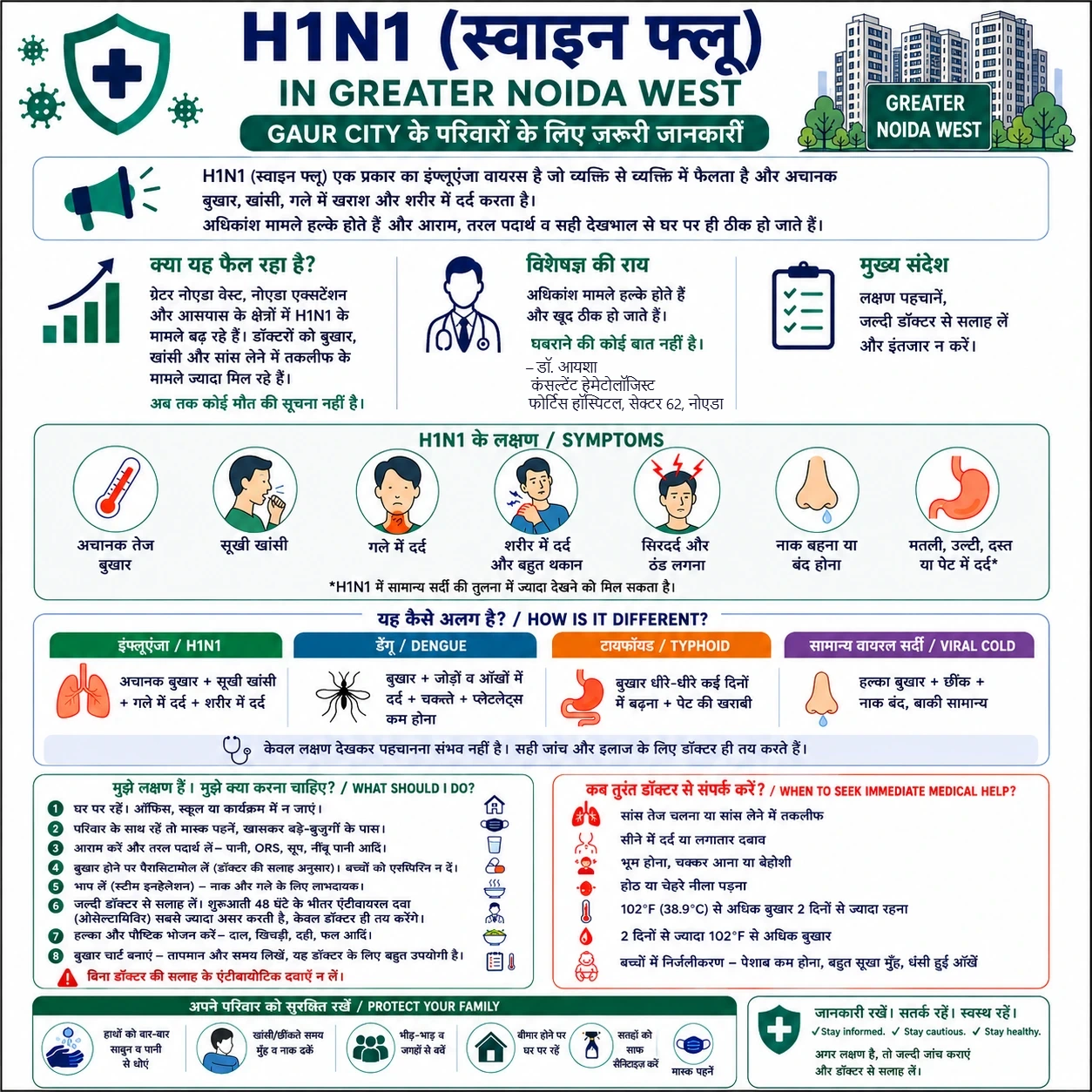
H1N1 Swine Flu in Greater Noida West: Symptoms, Tests & Care
Last updated: 22 August 2026 | Medically reviewed by Dr.…
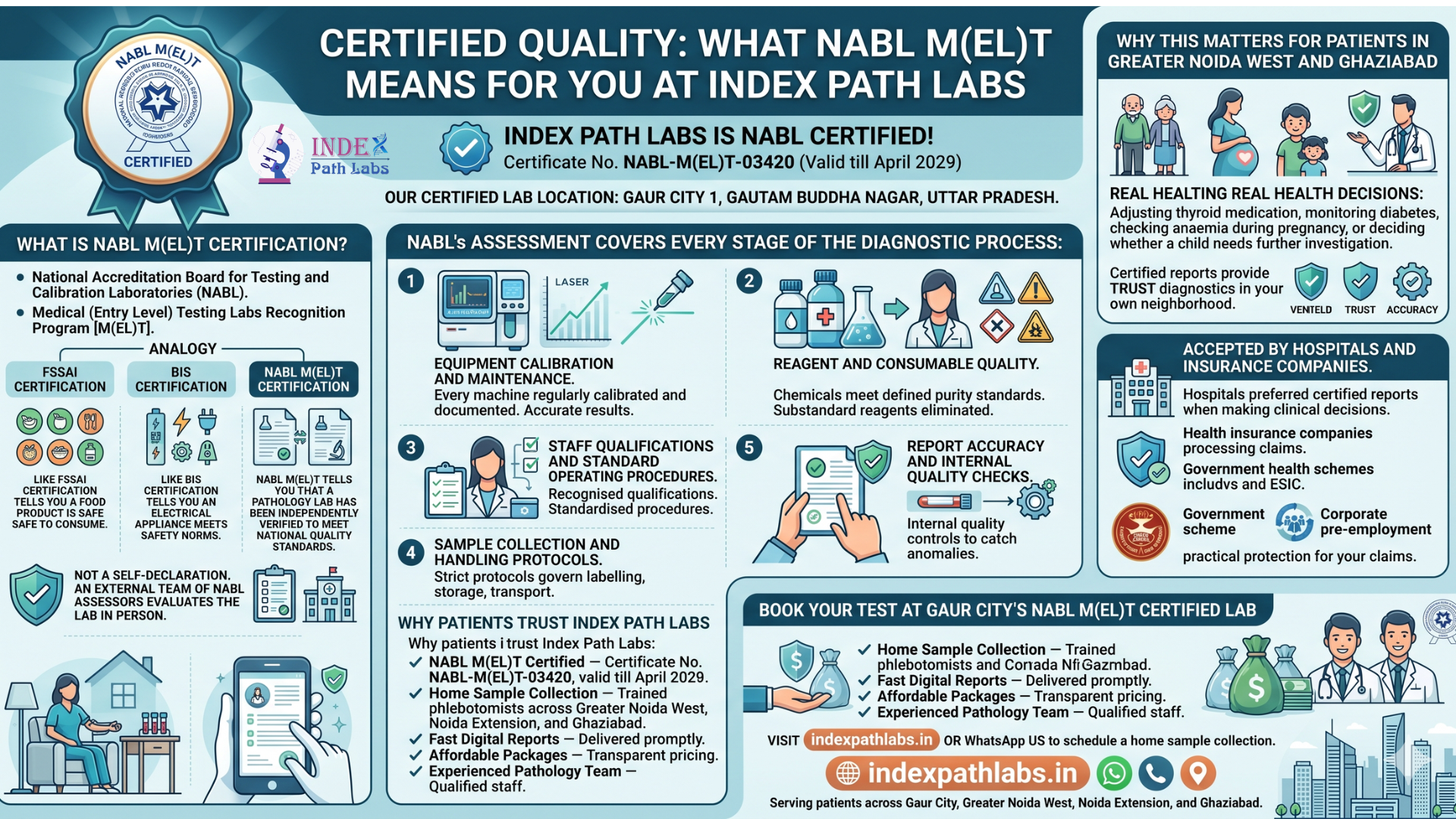
Why Sample Handling Matters: How Direct-to-Lab Testing Gives More Accurate Results
Lab Science · Diagnostics Why Sample Handling Matters: How Direct-to-Lab…
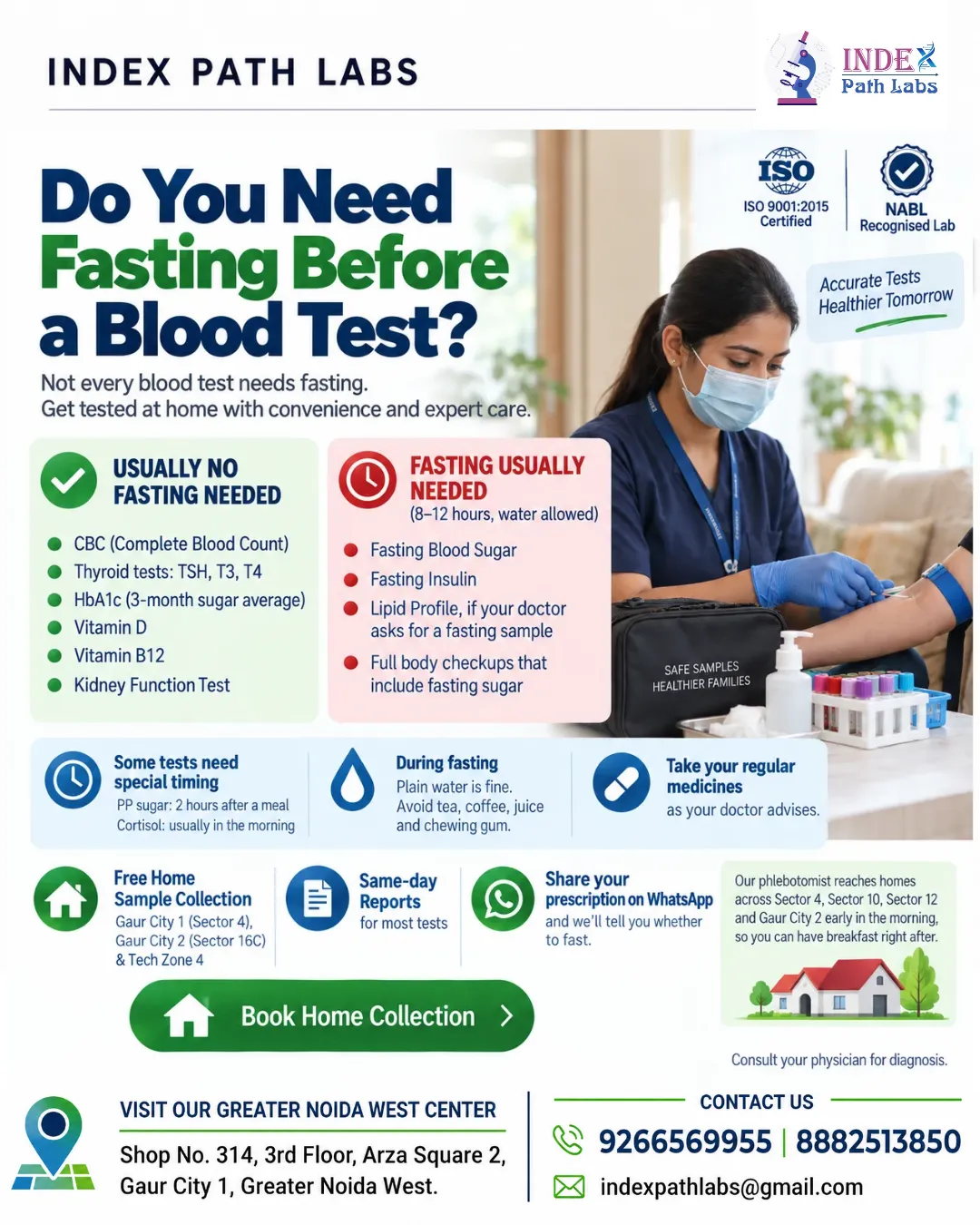
Fasting Before a Blood Test: Which Tests Need It and Which Don’t (Complete List)
Fasting Before a Blood Test: Which Tests Need It and…
One Reply to “Thyroid Test in Greater Noida West: When Should You Get Tested and What Does TSH Mean?”