
Last updated: 22 August 2026 | Medically reviewed by Dr. Puneet Paliwal, MBBS, MD
H1N1 (Swine Flu) in Greater Noida West — What Families in Gaur City Need to Know
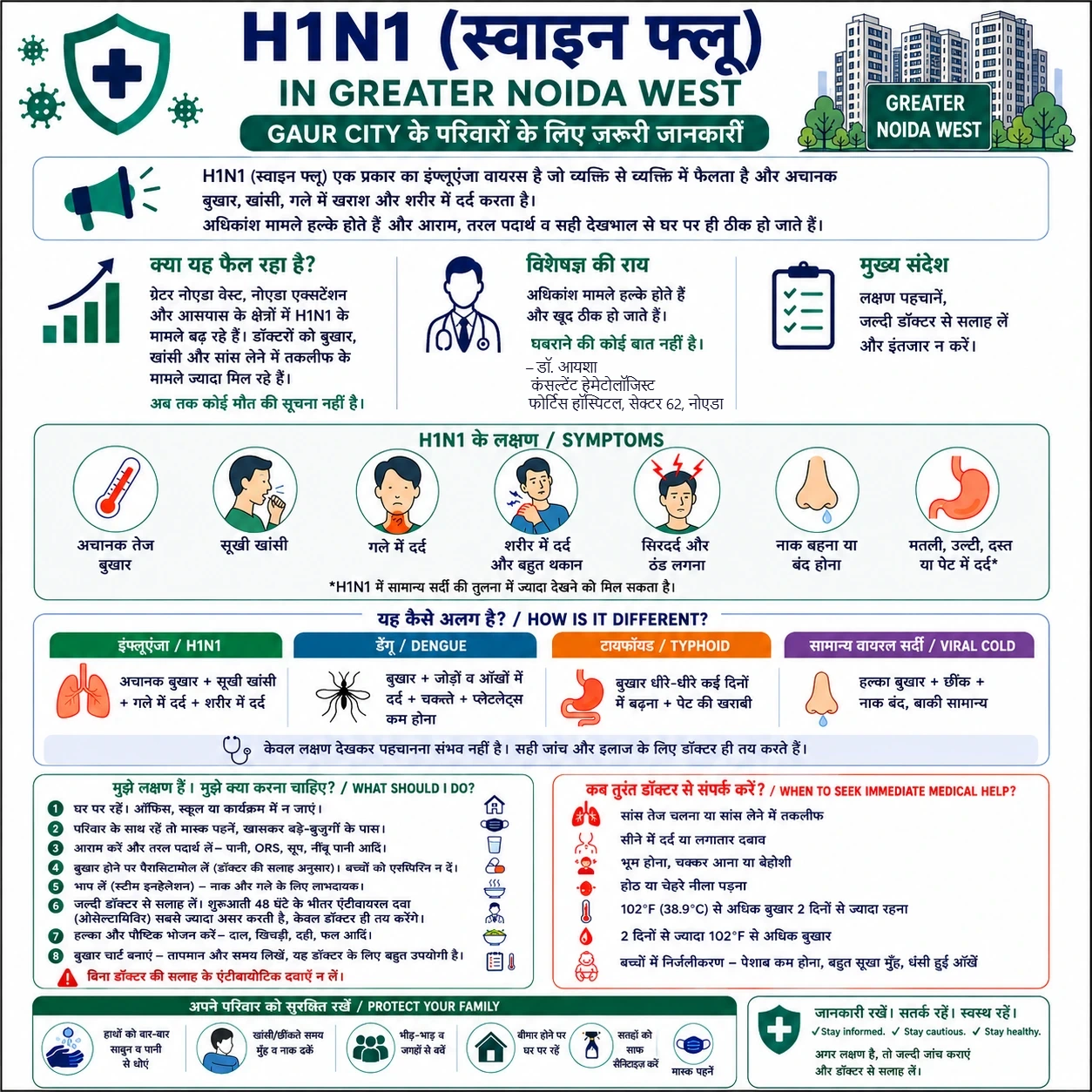
H1N1, also called swine flu, is a type of influenza virus that spreads from person to person and causes sudden fever, cough, sore throat and body aches. It is not caught from eating pork. In August 2026, cases have gone up sharply across Delhi, Noida and Ghaziabad — and most of them get better at home with rest, fluids and the right advice.
If you live in Gaur City 1, Gaur City 2 or anywhere around Char Murti, you have probably heard about it in your society WhatsApp group by now. This guide answers the questions people are actually asking: what the symptoms look like, when a test is needed, what to do if you already feel unwell, and how to protect the rest of the family if one person at home is infected.
Is swine flu really spreading in Delhi NCR right now?
Yes. As of 20 August 2026, Delhi had recorded 1,777 H1N1 cases this year, including 114 new cases on that single day — compared with 229 cases in the same period of 2025. No deaths have been reported. Doctors in Noida and Ghaziabad are seeing a similar rise in fever cases with cough and breathlessness.
Union Health Minister J.P. Nadda reviewed hospital preparedness on 21–22 August 2026. The Health Ministry’s message is simple: recognise symptoms early, and see a doctor instead of waiting it out.
Dr. Ayesha, Consultant Haematologist at Fortis Hospital, Sector 62, Noida, puts it plainly: the large majority of swine flu cases are mild and settle on their own within a few days. The sensible response is to watch for the danger signs listed below and see a doctor early — not to panic, and not to rush for a test most people do not need.
What are the symptoms of H1N1 swine flu?
H1N1 symptoms usually start suddenly, 1 to 4 days after you catch the virus. The Ministry of Health lists fever, cough, sore throat, headache, runny nose, body aches and tiredness as the main signs.
Think of it as a cold that hits much harder and much faster:
- Fever — sudden, often high
- Dry cough that keeps going
- Sore throat
- Body aches and severe tiredness — usually the worst part
- Headache and chills
- Runny or blocked nose
- Sometimes nausea, vomiting, loose motions or stomach cramps — more common in H1N1 than in an ordinary cold
One useful clue: with a normal cold, you feel a bit off. With flu, you often cannot get out of bed.
The cough and body ache can hang around for a couple of weeks even after the fever goes. That is normal and does not mean the illness is getting worse.
How is swine flu different from dengue, typhoid and a normal viral fever?
This is the most common confusion during monsoon in Greater Noida West, because all four are going around at the same time. Here is the honest answer: you cannot tell them apart reliably from symptoms alone — that is exactly why testing exists.
But there are patterns:
| Symptom pattern | Usually points toward |
|---|---|
| Sudden fever + dry cough + sore throat + body ache | Influenza / H1N1 |
| Fever + severe joint and eye pain + rash + falling platelets | Dengue |
| Fever that climbs step by step over days + stomach upset | Typhoid |
| Mild fever + sneezing + blocked nose, feeling okay otherwise | Ordinary viral cold |
Cough and sore throat lean toward flu. Rash and pain behind the eyes lean toward dengue. Your doctor decides which test to run — and in a bad monsoon week in Noida Extension, sometimes more than one is needed. We have covered the fever-vs-dengue question in more detail here: Dengue vs viral fever — which blood tests tell the difference.
How does H1N1 spread?
H1N1 spreads through tiny droplets released when an infected person coughs, sneezes or talks — these can travel up to about 6 feet. You can also catch it by touching a surface where the virus has landed and then touching your face. The virus can survive on surfaces for roughly 2 to 8 hours.
That is why lifts, school vans, society gates, coaching centres and crowded markets are where it moves fastest. In a high-rise township like Gaur City, one infected person in a lift can reach a lot of people in a day.
I have symptoms. What should I do first?
Start at home, not at the lab. Here is the order that actually helps:
- Stay home. Do not go to office, school or a family function. This one step protects more people than anything else.
- Wear a mask if you must be around family, especially elders.
- Rest and drink fluids — water, ORS, nimbu paani, soups, coconut water. Aim for plenty through the day.
- Take paracetamol for fever as advised. Never give aspirin to a child.
- Steam inhalation helps with a blocked nose and throat irritation.
- Call or visit your doctor — especially if you are in a high-risk group. Do this early. The antiviral medicine oseltamivir works best when started within the first 48 hours of symptoms, and only a doctor can decide if you need it.
- Eat light — dal, khichdi, curd, fruit. Nothing heavy or fried.
- Keep a fever chart. Note the temperature and time. It is the single most useful thing you can hand your doctor.
Do not self-medicate with antibiotics. Antibiotics do nothing against a flu virus.
When is an H1N1 test actually needed?
Under the Government of India’s categorisation used by Delhi’s health department, most mild cases do not need an H1N1 test at all. Testing is reserved for people who are seriously unwell. The system works in three categories:
- Category A — mild. Fever with cough or sore throat, and nothing more. No test needed, no antiviral needed. Stay home, treat symptoms, and review with your doctor after 24–48 hours.
- Category B — moderate or high-risk. High fever with a severe sore throat, or anyone in a high-risk group (pregnancy, young children, elderly, existing illness). Usually no test needed, but the doctor may start oseltamivir and advise home isolation.
- Category C — severe. Breathlessness, chest pain, drowsiness or confusion, low blood pressure, blood in the sputum, or bluish nails or lips. This group needs testing and immediate hospital admission.
If your doctor does order a swab test, the confirmatory test is an H1N1 RT-PCR on a throat or nasal swab. A rapid flu test gives a faster answer but misses a meaningful share of true cases, so a negative rapid test does not rule out flu in someone who is clearly unwell.
Index Path Labs arranges the H1N1 RT-PCR swab test through a referral partner laboratory, on a doctor’s prescription. Call +91 92665 69955 and we will confirm the current turnaround time before you book.
Which blood tests does the doctor usually ask for during a monsoon fever?
Even when an H1N1 swab is not required, your doctor will often want a basic fever workup — because the real question in August is which infection this is. Common tests in Greater Noida West right now:
- Complete Blood Count (CBC) with Platelet Count — the starting point for any fever, and the test that flags a falling platelet count
- Dengue NS1 Antigen and Dengue IgM/IgG — if dengue is suspected
- Widal / Typhidot — if typhoid is suspected
- Malaria Antigen
- CRP — to gauge how much inflammation is present
- Liver Function Test (LFT) and Kidney Function Test (KFT) — if the illness is dragging on or the patient is not improving
Index Path Labs offers free home sample collection for CBC, platelet count, dengue and typhoid tests across Gaur City 1, Gaur City 2 and Noida Extension, with same-day reports for most tests. For a household where someone has fever, that matters — nobody has to sit in a waiting room and share the infection around.
A lab detects. Your physician diagnoses and decides treatment.
Someone in my family is infected. What do we do?
This is the question we get asked the most. A practical plan for an Indian household:
Give the patient one room. One room, ideally one bathroom. Keep the door shut and a window open — fresh air genuinely helps.
One caregiver only. Pick one healthy adult — not a pregnant woman, not the grandparent, not a child. Fewer people exposed means fewer people sick.
Masks on both sides. The patient wears one when anyone enters. The caregiver wears one throughout.
Separate plates, glasses, towels and bedsheets. Wash them separately in hot water. Do not share.
Wash hands for 20 seconds — before and after entering that room, before eating, after touching anything the patient used.
Wipe down the shared surfaces daily — door handles, taps, switches, phone, TV remote.
Isolate for at least 7 days from the day symptoms started, or until 24 hours after the fever has gone without any fever medicine — whichever is later.
Watch the vulnerable people in the house. Elders and anyone with diabetes or heart or lung disease should be checked on daily. If they develop fever, call the doctor the same day rather than waiting.
Watch for the danger signs below — in the patient and in everyone else.
Danger signs: when to go to hospital immediately
Do not wait for morning, do not wait for the fever to break. Go to the nearest hospital if you see:
- Breathlessness or fast, difficult breathing
- Chest pain or pressure
- Bluish lips, face or nails
- Confusion, drowsiness, or difficulty waking up
- Fever that will not come down despite medicine
- Blood in the sputum
- Not passing urine, or no tears when crying (in children)
- A child who is unusually sleepy, refuses fluids, or has a fever with a rash
- Someone who seemed to be improving and then suddenly got worse again
Those are the Category C signs. They need a hospital, not a home remedy.
How do I stay safe from swine flu?
There is no magic shield, but these steps genuinely reduce your chances:
- Wash your hands often, with soap, for 20 seconds. Carry a sanitiser for the lift and the market.
- Cover coughs and sneezes with a tissue or your elbow — never your bare palm.
- Do not touch your face with unwashed hands.
- Mask up in crowded indoor places — Gaur City Mall, the metro, clinics, school gates.
- Keep your distance from anyone who is coughing, about a metre where you can.
- Stay home when you are ill. Sending a coughing child to school is how one case becomes twenty.
- Ask your doctor about the annual influenza vaccine. Influenza vaccines used since 2010 include protection against the H1N1 strain, and health authorities recommend annual vaccination especially for pregnant women, young children, adults over 65, and anyone with diabetes, heart, lung or kidney disease. Whether it is right for you is a decision for your physician.
- Sleep, eat properly, drink water. Unglamorous, and it still matters.
Who is at higher risk?
Most healthy adults recover at home. These groups should contact a doctor early rather than waiting:
- Pregnant women, in any trimester
- Children under 5, particularly under 2
- Adults over 65
- People with diabetes, heart disease, asthma or other lung disease, kidney or liver disease
- People with weakened immunity, including those on long-term steroids or cancer treatment
- People with severe obesity
Being in one of these groups does not mean you will get very ill. It means the doctor should be involved sooner.
Frequently Asked Questions
Can I get swine flu from eating pork?
No. H1N1 spreads from person to person through respiratory droplets. Properly cooked pork does not transmit it.
How long does swine flu last?
Fever usually settles within 3 to 5 days in mild cases. The cough and tiredness can last a week or two longer. If the fever crosses 5 days or comes back after settling, see your doctor.
Is an H1N1 test needed for every fever?
No. Under the Government of India categorisation, only severe cases — Category C — require an H1N1 test. Most fevers are managed on symptoms, with a CBC and other blood tests to rule out dengue or typhoid.
What sample is taken for an H1N1 test?
A throat swab or a nasal (nasopharyngeal) swab, tested by RT-PCR. It is not a blood test. Index Path Labs arranges this test through a referral partner laboratory on a doctor’s prescription.
Can I get a blood test done at home in Gaur City?
Yes. Index Path Labs provides free home sample collection across Gaur City 1, Gaur City 2, Sector 4, Sector 16C, Tech Zone 4 and nearby Greater Noida West sectors. A trained phlebotomist visits your flat, so a person with fever does not have to travel.
How soon will I get my report?
Same-day reports for most routine tests, including CBC and platelet count. Reports are shared digitally on WhatsApp.
My whole family has fever. Should everyone get tested?
Ask your doctor first. Often one or two tests in the household are enough to identify what is circulating, and the rest are treated on symptoms.
Does a normal CBC mean I definitely do not have swine flu?
No. A CBC helps your doctor understand the overall picture and rule out other causes such as dengue. It is not a test for H1N1.
Why families in Greater Noida West choose Index Path Labs
- Free home sample collection across Gaur City 1, Gaur City 2, Sector 4, Sector 16C and Tech Zone 4 — so a person with fever stays in bed, not in a queue
- Same-day reports for most tests, delivered digitally on WhatsApp
- ISO 9001:2015 certified processes
- Rated 5.0 on Google by 111+ patients across Greater Noida West
- Trained phlebotomists who are used to collecting from elderly patients and young children at home
- Right here in the neighbourhood — Aarza Square 2, Gaur City 1, serving families from Char Murti to Crossings Republik
Book a home collection
Fever in the house? Get the blood tests your doctor asked for done at home in Gaur City — free sample collection across Greater Noida West, same-day reports for most tests.
WhatsApp or call +91 92665 69955
📍 Index Path Labs — Shop No. 314, 3rd Floor, Aarza Square 2, Greater Noida West Road, Gaur City 1, Sector 4, Ghaziabad, Uttar Pradesh 201009
This article is for general information only and is not a substitute for professional medical advice. Index Path Labs is a diagnostic laboratory — laboratory tests support your physician’s assessment; they do not replace it. Consult your physician for diagnosis & treatment.
Related Posts
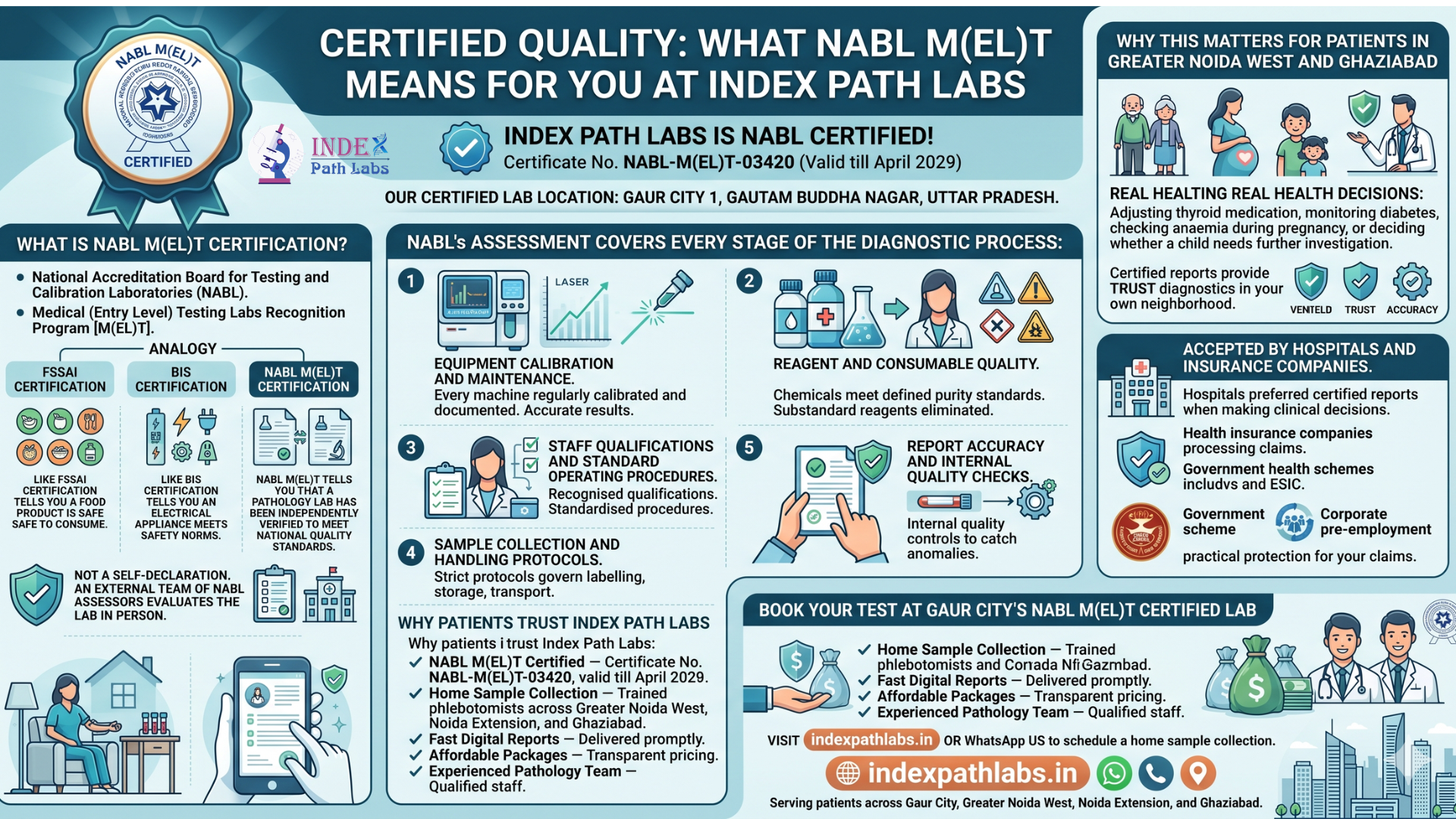
Why Sample Handling Matters: How Direct-to-Lab Testing Gives More Accurate Results
Lab Science · Diagnostics Why Sample Handling Matters: How Direct-to-Lab…
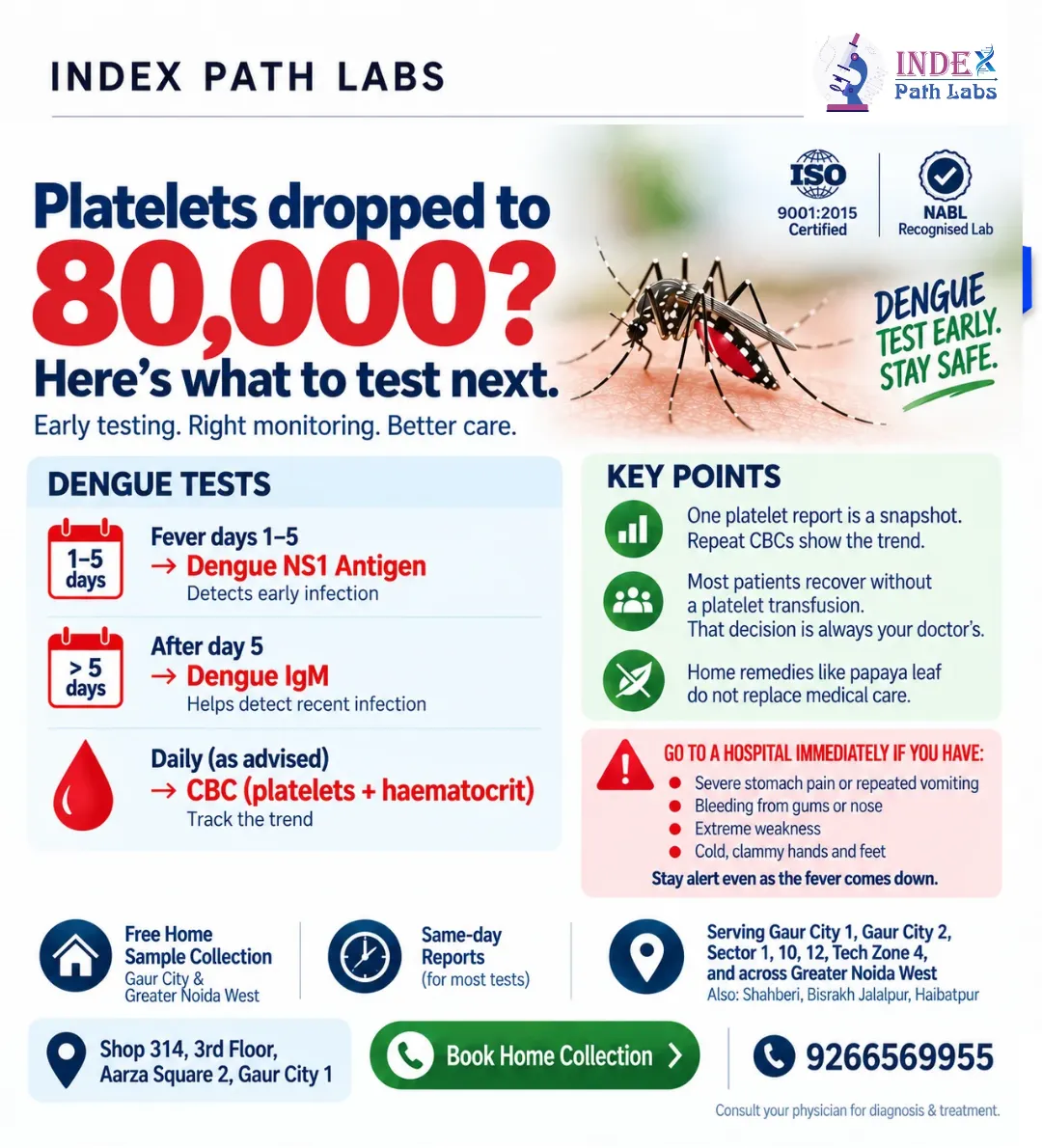
Dengue Platelet Count Dropped to 80,000? What to Test, What to Ignore and When to Go to Hospital
Dengue Platelet Count Dropped to 80,000? What to Test, What…
Understanding Your Semen Analysis Report
Understanding Your Semen Analysis Report Looking to book rather than…