Imagine you woke up feeling unwell — maybe tired, a little dizzy, or just “not right.” Your doctor asks for a blood test. You visit a nearby collection centre, give your sample, and wait a day for results. But here is something most people in Gaur City, Greater Noida West, and Ghaziabad never think about: by the time your blood reaches the lab, has it been handled properly?
For busy families, working professionals, and senior citizens across Noida Extension and Delhi NCR, getting a blood test can feel routine. But the truth is, how your sample is collected, stored, and transported to the lab can make a surprisingly big difference to the accuracy of your results — and therefore to your health decisions. Let us break this down in a simple, easy-to-understand way.
Quick fact: According to laboratory medicine experts, up to 60–70% of errors in diagnostic testing happen before the sample even reaches the lab — during collection, labelling, or transport. Knowing this can help you choose the right lab.
What Is “Sample Handling” and Why Should You Care?
When a lab technician draws your blood, collects your urine, or takes a swab, that sample is a fragile, living snapshot of what is happening inside your body right now. Blood cells break down. Hormones degrade. Bacterial growth can alter readings. All of this can happen within hours — sometimes even minutes — if the sample is not cared for correctly.
“Sample handling” refers to every step from the moment your sample is collected to the moment it is tested in the machine. This includes:
Collection
Right needle, right tube, right technique — done by a trained phlebotomist.
Labelling
Your sample must be clearly marked with your name, time, and test type immediately.
Storage
Some samples need cold storage (2–8°C). Leaving them at room temperature can corrupt results.
Transport
The sample must reach the lab quickly, without shaking, heat exposure, or delay.
Processing
Centrifugation, separation, and machine testing — done in a controlled lab environment.
A weakness at any single step can silently alter your test result — even if the machines in the lab are perfectly calibrated.
The Hidden Risks of Multi-Stop Sample Collection
In many parts of Uttar Pradesh and Delhi NCR — including areas like Ghaziabad and Noida Extension — there are small collection booths or franchise centres that gather samples and then transport them in batches to a central lab, sometimes hours later. This is called a “multi-stop” or “relay” model.
This is not always a problem. But it does introduce risks that most patients are completely unaware of.
| Risk Factor | Multi-Stop Model | Direct-to-Lab Model |
|---|---|---|
| Time before processing | 2–8 hours possible | Under 2 hours typical |
| Cold chain maintained? | Not always guaranteed | Controlled environment |
| Sample shaking during transit | Higher chance (longer roads) | Minimal — direct route |
| Haemolysis risk (blood cell rupture) | Higher | Lower |
| Reporting time | Often 24–48 hours | Often same day |
What is haemolysis and why does it matter?
Haemolysis (hee-MOL-ih-sis) is when red blood cells break open and leak their contents into the blood sample. This can happen due to rough handling, too much heat, or a delayed journey. When haemolysis happens, tests like potassium, LDH, bilirubin, and iron levels can show falsely high or low readings — meaning your doctor could make decisions based on numbers that do not reflect reality.
For residents of Gaur City and Greater Noida West who are managing conditions like diabetes, thyroid disorders, or heart disease, an inaccurate result is not just inconvenient — it can lead to incorrect treatment.
Direct-to-Lab Testing: What Makes It Different?
A “direct-to-lab” model means that the same organisation that collects your sample also processes and reports it — with no third-party handoffs, no batch waiting, and no broken cold chain.
This approach is especially valuable for tests that are time-sensitive, including:
- Thyroid Function Tests (TSH, T3, T4) — hormones degrade quickly at room temperature
- Blood Sugar (Glucose, HbA1c) — glucose continues to be consumed by blood cells after collection
- Complete Blood Count (CBC) — white cell counts can shift within hours
- Liver Function Tests — bilirubin and enzymes are sensitive to heat and light
- Hormone Panels (testosterone, oestrogen, cortisol) — highly sensitive to handling conditions
Whether you are a working professional in Noida Extension who needs a quick pre-employment health checkup, or a senior resident in Gaur City monitoring a chronic condition, the direct-to-lab model simply gives you results you can trust more.
Home Sample Collection — the best of both worlds
Many families in Greater Noida West and Ghaziabad find it difficult to visit a lab in the morning — especially with elderly parents, young children, or busy work schedules. Home sample collection by a trained phlebotomist — followed by direct transport to your own lab — combines the convenience of staying home with the accuracy of a proper lab environment.
The key is ensuring the phlebotomist is from the same lab that will process your sample. This single detail eliminates the relay chain entirely.
Frequently Asked Questions
+
Yes — for several common tests, it can. Blood glucose, for example, drops by up to 10 mg/dL per hour at room temperature because the blood cells keep using sugar. Similarly, potassium levels can appear falsely elevated if the sample sits too long before centrifugation. For tests like thyroid hormones or liver enzymes, the difference may be small — but for borderline results, it can push a normal value into an abnormal range, or vice versa.
+
When done by a trained phlebotomist from the same diagnostic lab, home collection is equally accurate. The phlebotomist uses the correct tubes, labels them immediately, and transports the sample in temperature-controlled conditions directly to the processing lab. Problems arise only when collection is done by an untrained person or when the sample goes through multiple intermediaries.
+
You can ask the lab directly: Do they collect and process in-house? How long does it take from collection to processing? Are cold-chain protocols followed for temperature-sensitive tests? A reliable lab will have clear answers. At Index Path Labs, our phlebotomists follow a strict sample management protocol for every collection across Gaur City, Greater Noida West, and Ghaziabad.
+
Tests most sensitive to handling include blood glucose, potassium, ammonia, lactic acid, thyroid hormones, cortisol, haemogram (CBC), and bilirubin. Tests that are more stable include lipid profiles and HbA1c — but even these can be affected by haemolysis or extreme temperature exposure.
+
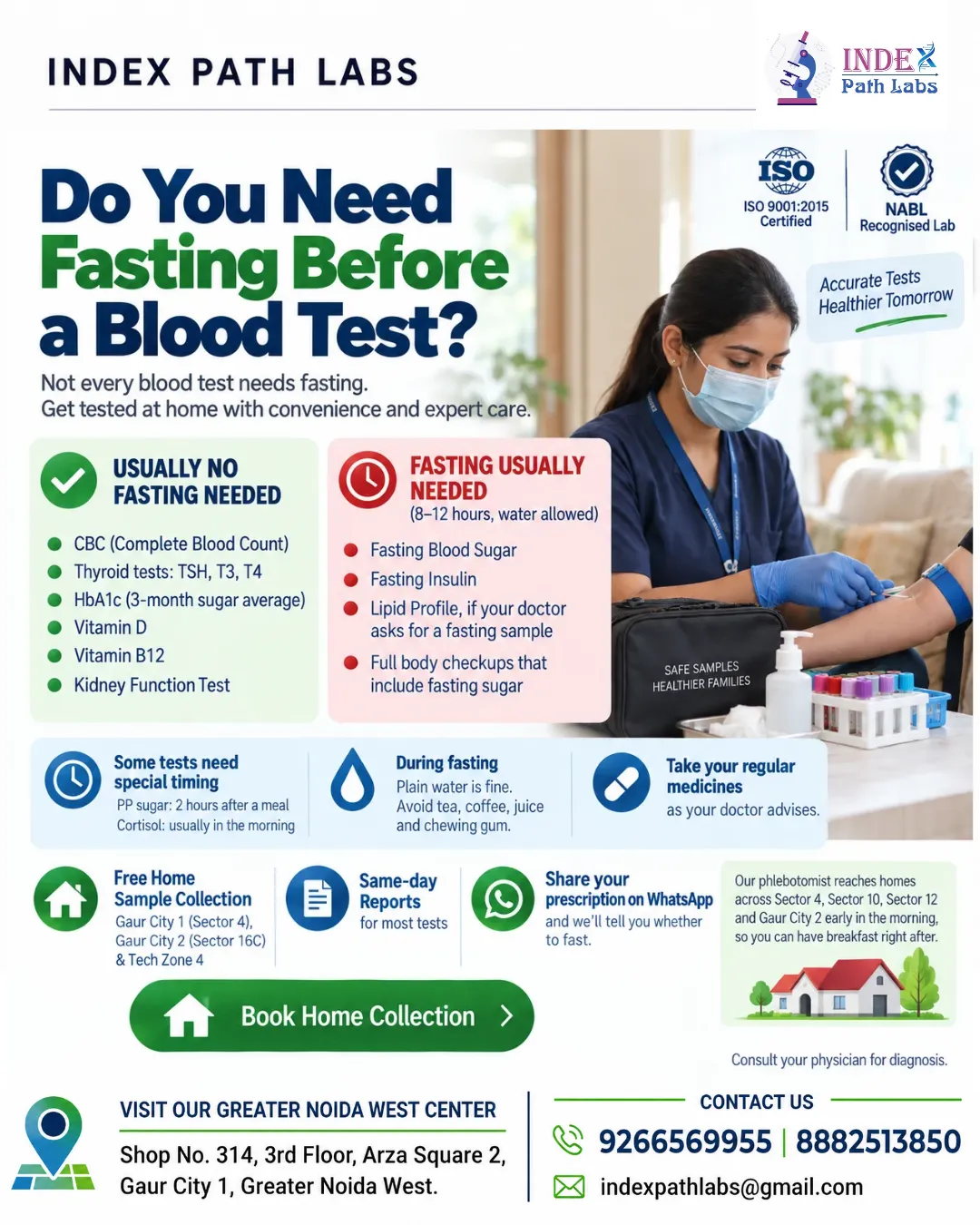
Not for all tests. Tests that require fasting (8–12 hours) include blood glucose, lipid profile, and full-body health packages. Tests like thyroid function, CBC, kidney function, and urine tests generally do not need fasting — but it is always best to confirm with your lab before your appointment. Index Path Labs will guide you on preparation when you book.
Why Residents of Gaur City & Greater Noida West Choose Index Path Labs
Serving patients across Ghaziabad, Noida Extension, and Delhi NCR
-
✓
In-house processing, no relay chains — your sample is collected and tested entirely within our own network, eliminating handoffs that compromise quality. -
✓
Trained phlebotomists at your doorstep — our team covers Gaur City, Greater Noida West, Noida Extension, and surrounding areas in Ghaziabad for safe, professional home sample collection. -
✓
Cold-chain compliant transport — temperature-sensitive samples are stored and transported in proper cool-box conditions so hormones, enzymes, and glucose levels stay accurate. -
✓
Fast, digital reports — results delivered to your WhatsApp or email, typically on the same day or next morning, so you and your doctor can act quickly. -
✓
Affordable packages for families — from individual tests to comprehensive wellness packages, our pricing is transparent and designed for middle-class families across Uttar Pradesh and Delhi NCR.
Book Your Test from the Comfort of Home
Whether you are in Gaur City, Greater Noida West, Noida Extension, or Ghaziabad — Index Path Labs brings accurate, direct-to-lab diagnostics to your doorstep. No relay chains. No cold-chain worries. Just results you can trust.